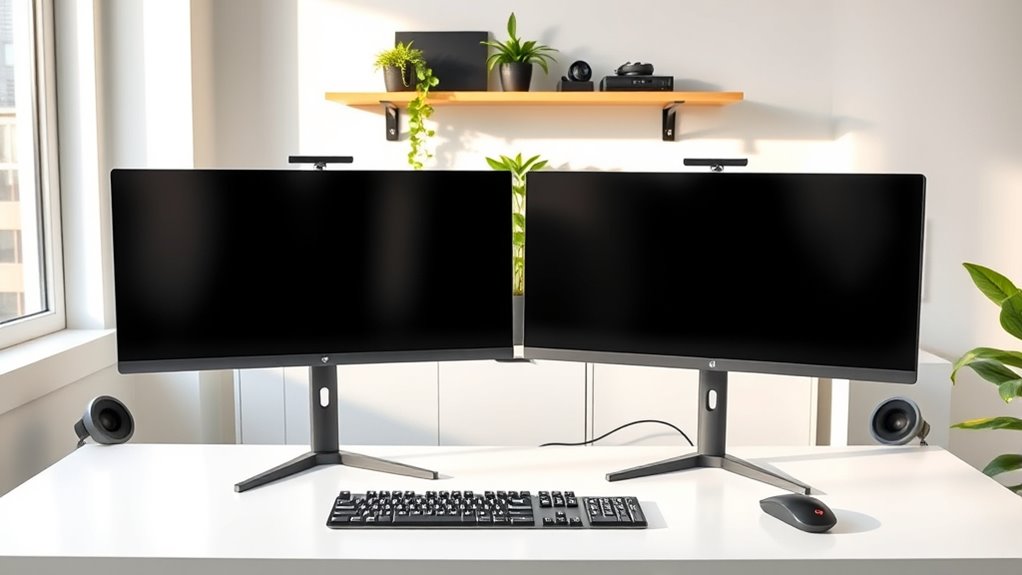

To establish dual monitors for better productivity, start by choosing monitors that fit your workspace and needs, considering resolution and panel types. Connect them with compatible cables and adjust display settings on your computer to extend or duplicate your screens. Arrange the monitors physically for comfortable viewing and set appropriate resolutions. Creating multiple desktops can boost organization, and troubleshooting common issues ensures smooth operation. Keep exploring to learn the detailed steps for a seamless, efficient setup.
Key Takeaways
- Choose monitors with compatible ports, appropriate resolution, and size to suit your workspace and workflow needs.
- Connect monitors securely using correct cables and adapters, ensuring all ports and connections are functioning properly.
- Configure display settings to extend or duplicate screens, arrange monitor positions physically and digitally, and set recommended resolutions.
- Position primary and secondary monitors ergonomically to reduce neck strain and improve workflow efficiency.
- Regularly update graphics drivers, organize applications across desktops, and troubleshoot connection issues for optimal productivity.
Choosing the Right Monitors for Your Workspace

When selecting monitors for your workspace, it’s important to take into account factors like size, resolution, and panel type to ensure they meet your specific needs. If you work with detailed graphics or videos, opt for a higher resolution, such as 1440p or 4K, to get sharper images. Consider the monitor size based on your desk space and how much screen real estate you need; larger screens improve multitasking but require more space. Panel type also matters: IPS panels offer better color accuracy and wider viewing angles, ideal for creative work, while TN panels are faster and more affordable but have inferior color quality. Think about your primary tasks and budget to choose monitors that enhance your productivity and comfort. Additionally, selecting monitors with appropriate net worth considerations can help ensure long-term investment value.
Gathering Necessary Cables and Adapters
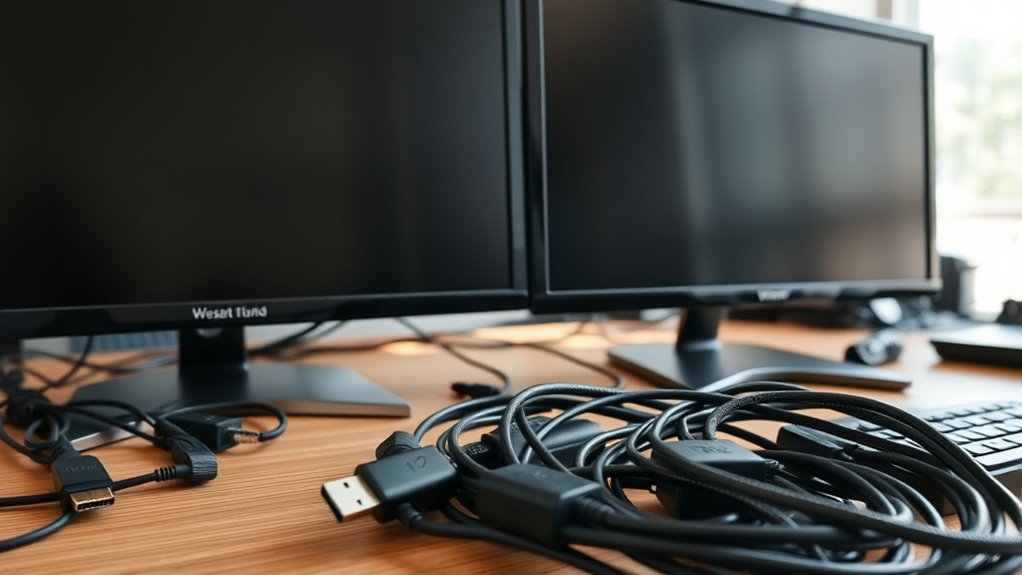
Before connecting your monitors, gather all the necessary cables and adapters to guarantee a smooth setup. Check the ports on your computer and monitors to determine which cables you’ll need, such as HDMI, DisplayPort, DVI, or VGA. If your devices have different port types, pick the appropriate adapters to bridge the gap. It’s a good idea to have extras on hand in case of cable damage or compatibility issues. Make sure all cables are long enough to reach comfortably from your computer to your monitors without tension. Organizing your cables and adapters beforehand can prevent tangling or confusion during setup. Having everything ready saves time and reduces frustration, helping you smoothly progress into connecting your monitors. Additionally, understanding input lag and refresh rates can help you choose the right cables and settings for optimal display performance.
Connecting Your Monitors to Your Computer
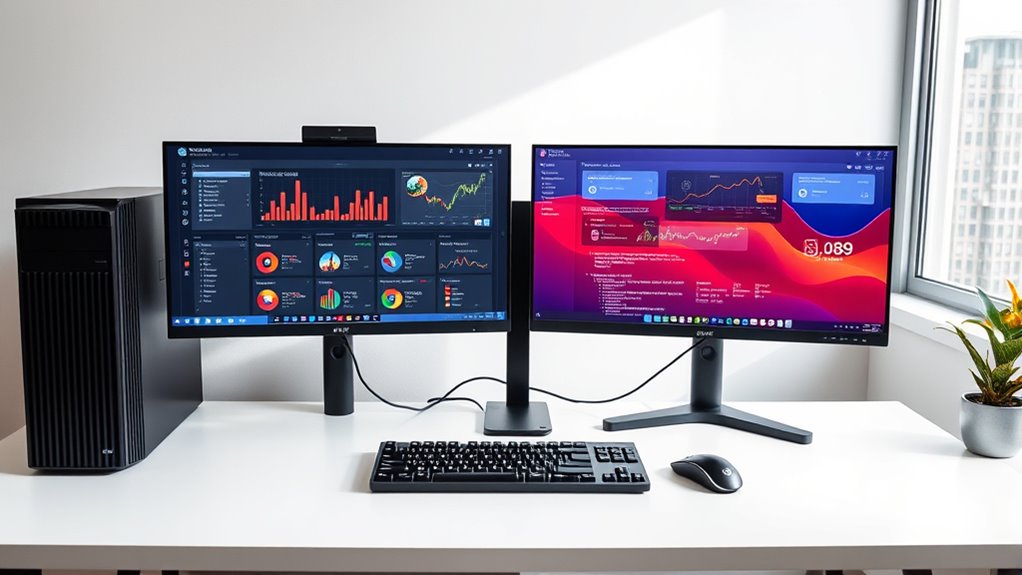
Start by checking which ports your computer has and guarantee your monitors have compatible connections. Use the correct cables to connect each monitor securely to avoid display issues. Once connected, you’ll need to adjust your display settings for ideal viewing across both screens. Additionally, consider leveraging energy-efficient hardware to optimize your setup for sustainability and reduce power consumption.
Check Compatible Ports
To connect your monitors properly, you need to verify that your computer’s ports match the input options on your displays. Check the available ports on your computer—these could be HDMI, DisplayPort, DVI, or VGA. Then, examine your monitors to see which inputs they support. If your computer has an HDMI port and your monitor also has an HDMI input, you’re all set. If not, you might need adapters or different cables to bridge incompatible ports. Make sure the ports are compatible to avoid connection issues or degraded image quality. Confirming this compatibility beforehand saves you time and prevents frustration during setup. Paying attention to port compatibility ensures a smoother connection process. Once you’ve identified matching ports, you’re ready to move on to the next step of connecting your monitors securely.
Use Proper Cables
Once you’ve identified the compatible ports on your computer and monitors, selecting the right cables is the next step. Using the correct cables guarantees a stable connection and ideal display quality. For example, HDMI and DisplayPort cables handle high resolutions and refresh rates well, while VGA or DVI might limit quality. Check your ports and choose cables accordingly. Here’s a quick comparison:
| Cable Type | Best For |
|---|---|
| HDMI | General use, high-res displays |
| DisplayPort | Gaming, high-refresh-rate tasks |
| DVI | Older monitors, decent quality |
| VGA | Legacy monitors, basic display |
| USB-C | Modern laptops, versatile use |
Using the right cable prevents issues like flickering or low resolution, ensuring a seamless dual-monitor experience. Proper cable selection is an essential part of building a reliable connection, especially when considering the infrastructure involved in modern setups.
Adjust Display Settings
After connecting your monitors to your computer, the next step is to adjust the display settings to guarantee everything looks right. Open your computer’s display settings by right-clicking on the desktop and selecting “Display Settings.” Here, you’ll see options to arrange your monitors, set their resolution, and choose the main display. Make sure each monitor is identified correctly, then drag the icons to match their physical placement. Adjust the resolution for clarity and select whether to extend or duplicate your displays. If needed, tweak the scaling to ensure text and icons are comfortably visible. Preview your setup to confirm everything lines up smoothly. Properly configuring these settings assures a seamless, productive dual-monitor experience. Understanding display configurations can help optimize your setup for better productivity and visual comfort.
Configuring Display Settings on Windows
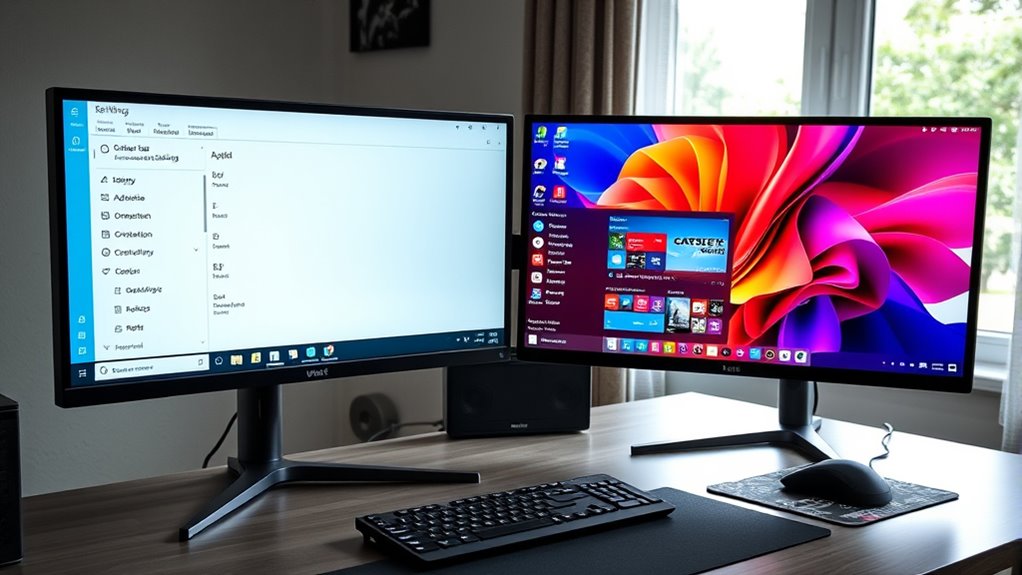
To get your monitors working just right, you’ll need to adjust the display resolution and set your main monitor. Windows makes this easy with simple options in the Display Settings menu. Once you fine-tune these settings, your dual monitor setup will look and function exactly how you want. Additionally, understanding Free Floating concepts can help you optimize your workspace for better productivity and comfort.
Adjusting Display Resolution
Ever wonder how to make your dual monitors look their best? Adjusting display resolution ensures sharp images and proper scaling. To do this effectively:
- Right-click on your desktop and select “Display settings.”
- Choose the monitor you want to adjust from the diagram.
- Scroll to “Display resolution” and select the recommended setting.
- Click “Apply” to save changes.
- For optimal viewing, consider how visual clarity impacts your overall productivity and comfort during extended use.
Selecting the ideal resolution helps avoid blurry text and distorted images. Higher resolutions provide sharper visuals but can slow performance on older hardware. Conversely, lower resolutions increase performance but reduce clarity. Experiment with different settings to find the perfect balance for your setup. Keep in mind, the recommended resolution is usually the best choice for your monitor. Adjusting resolution correctly enhances clarity and productivity without sacrificing performance.
Setting Main Monitor
| Step | Action | Result |
|---|---|---|
| 1 | Right-click desktop, select “Display settings” | Opens display configuration window |
| 2 | Select desired monitor | Highlights specific screen |
| 3 | Check “Make this my main display” | Sets primary monitor |
Adjusting Display Settings on Macos
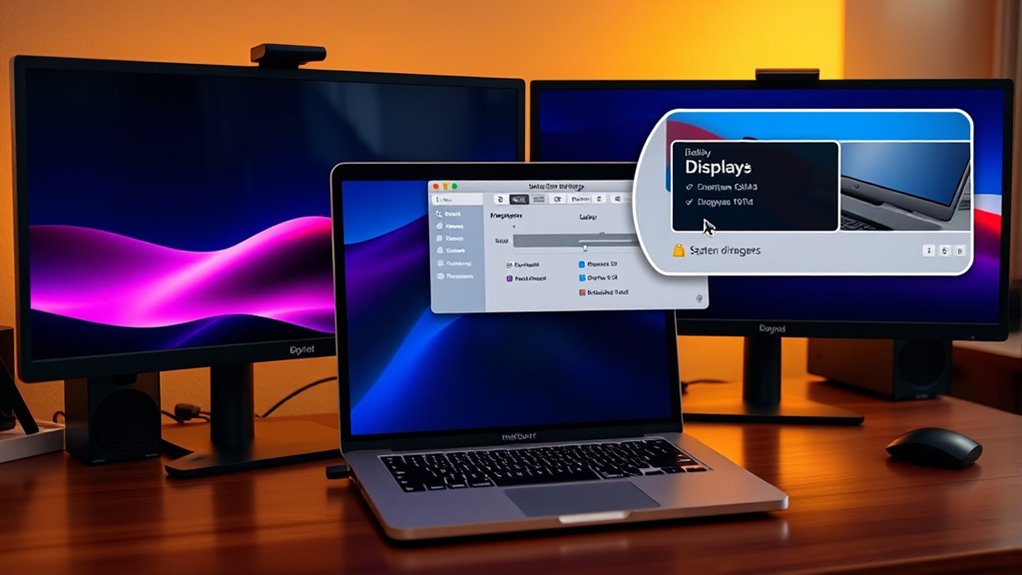
When setting up dual monitors on your Mac, adjusting display settings is vital to guarantee everything looks just right. First, open System Preferences and click on Displays. Here, you can modify resolution settings for each monitor to ensure clarity. Second, adjust the refresh rate if your monitor supports higher speeds for smoother visuals. Third, select the ‘Default for display’ or ‘Scaled’ options to fine-tune how content appears. Fourth, check the color profiles by navigating to the Color tab, ensuring accurate color reproduction. These adjustments help optimize image clarity, motion smoothness, and color accuracy, creating a seamless dual-monitor experience. Properly configuring these settings guarantees your workspace is tailored for productivity and visual comfort. Additionally, understanding safe installation practices can help prevent setup issues and extend the longevity of your monitors.
Arranging Your Monitors for Optimal Workflow
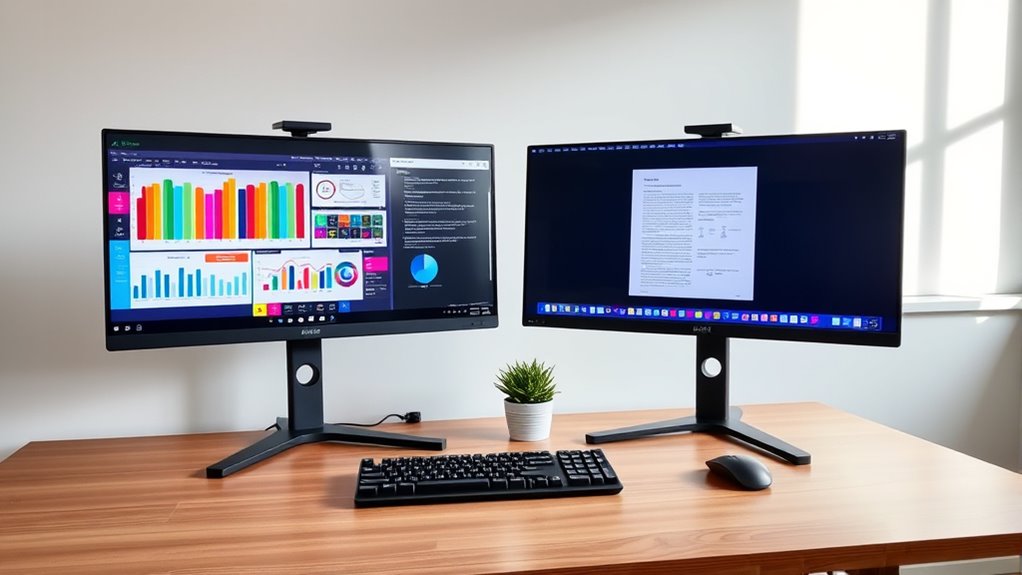
After adjusting your display settings, the next step is arranging your monitors to fit your workflow. Position your primary monitor directly in front of you at eye level for comfortable viewing. Place the second monitor adjacent to it, aligning the top edges to minimize neck movement. Consider how you use applications: if you frequently reference one while working on another, position the reference monitor on the side you turn to most often. Keep essential tools and communication apps within your main field of vision. Use a stable stand or mount to prevent shifting during use. Maintain a slight angle between monitors to create a seamless viewing experience. Proper arrangement reduces strain and enhances efficiency, making multitasking smoother and more natural. Effective monitor placement can also help prevent discomfort and support your overall well-being during long work sessions.
Fine-Tuning Display Resolution and Orientation
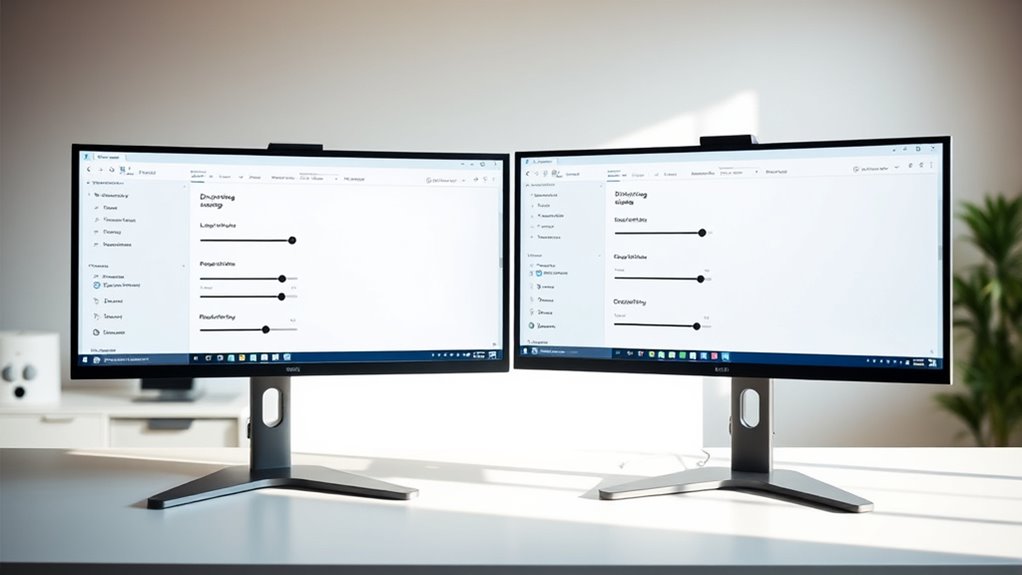
Adjusting your display resolution and orientation is essential for achieving the best visual experience and comfort. Proper settings reduce eye strain and improve clarity across both screens. To optimize, start by selecting a resolution that matches each monitor’s native settings for sharpness. Ensure the orientation aligns with how you plan to use each display—landscape or portrait—based on your workflow. Here are some tips to fine-tune your setup:
- Choose the native resolution for crisp images.
- Match resolution settings across monitors for consistency.
- Set the primary monitor with the best resolution.
- Adjust orientation based on specific tasks, like reading long documents or coding.
Making these adjustments helps you work more efficiently and comfortably.
Setting Up Multiple Desktops and Virtual Workspaces
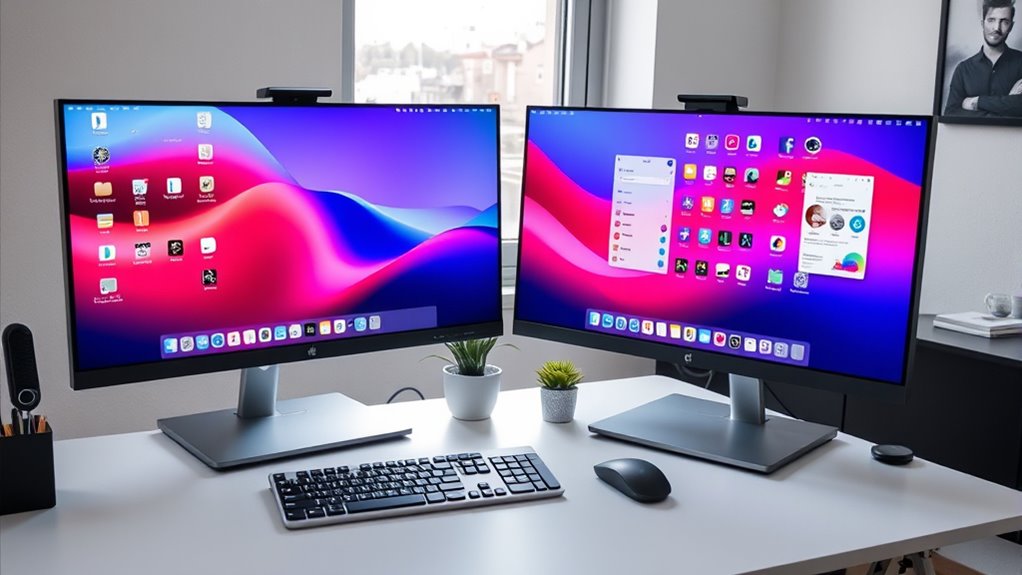
Setting up multiple desktops and virtual workspaces allows you to organize your tasks more efficiently, reducing clutter and enhancing productivity. By creating separate spaces for different projects or types of work, you can switch smoothly between tasks without losing focus. On Windows, press Win + Tab or use the Task View button to add new desktops. On macOS, swipe up with three fingers or use Mission Control to create spaces. You can assign specific applications to each workspace, keeping your screen clear and focused. This setup helps you avoid switching between overlapping windows and minimizes distractions. Take advantage of keyboard shortcuts to move quickly between desktops, making your workflow more seamless. Virtual workspaces guarantee your workspace stays organized, letting you concentrate on what matters most.
Troubleshooting Common Dual Monitor Issues

When you’re troubleshooting dual monitor issues, the first step is to identify the specific problem you’re facing, such as display not showing, resolution errors, or misalignment. Once you know the issue, you can take targeted steps to fix it.
Identify the specific dual monitor issue to find the most effective solution quickly.
Here are some common solutions:
- Check your cable connections to ensure they’re secure and undamaged.
- Update or reinstall your graphics card drivers for compatibility.
- Adjust display settings in your operating system to correct resolution or alignment.
- Restart your computer and monitor to reset any temporary glitches.
Frequently Asked Questions
Can I Use Different Monitor Brands Together Effectively?
Yes, you can use different monitor brands together effectively. Focus on matching key specifications like resolution, refresh rate, and size to guarantee a seamless experience. Connect them using compatible cables and adjust display settings to align colors and brightness. While the visual experience may vary slightly, with proper calibration, you’ll find that mixing brands can work well without sacrificing productivity or display quality.
How Do I Prevent Screen Flickering on Dual Monitors?
Don’t let flickering throw you for a loop. First, check your monitor and graphics card connections to make sure they’re secure. Update your graphics drivers to the latest version, as outdated drivers often cause display issues. Adjust your refresh rate settings in your display settings; matching them across monitors helps. If problems persist, try switching cables or ports. Sometimes, a little tinkering keeps your workspace running smoothly without missing a beat.
What Safety Precautions Should I Consider When Setting up Monitors?
When setting up your monitors, make sure to place them on a stable surface to prevent falls or damage. Keep cables organized to avoid tripping hazards and guarantee proper airflow to prevent overheating. Use surge protectors to safeguard against power surges, and check that your electrical outlets are properly grounded. Always follow manufacturer instructions and avoid overloading circuits to maintain a safe workspace.
Is It Possible to Connect More Than Two Monitors?
Yes, you can connect more than two monitors. Verify your computer’s graphics card capabilities to see how many displays it supports. You might need extra adapters or a docking station to connect multiple monitors, especially if your device doesn’t have enough ports. Make sure your graphics drivers are up-to-date for peak performance. With the right setup, you can expand your workspace and boost your productivity considerably.
How Can I Secure My Dual Monitor Setup From Theft or Damage?
Think of your monitors as treasures on display, and you want to keep them safe. To prevent theft, secure them with Kensington locks or install security cables. Protect against damage by placing monitors on stable surfaces, avoiding overcrowded spaces, and using surge protectors to guard against electrical surges. Keep an eye on your setup, and consider installing security cameras if you’re in a high-risk area, ensuring your investment stays safe.
Conclusion
With your monitors now seamlessly aligned, imagine your workspace as a well-orchestrated symphony, each screen harmonizing to boost your productivity. As you gaze across your dual displays, picture the endless possibilities unfolding—more open windows, clearer visuals, and effortless multitasking. With everything set up just right, you’ll feel the flow of work easier than ever, turning your desk into a command center where focus and efficiency thrive in perfect harmony.