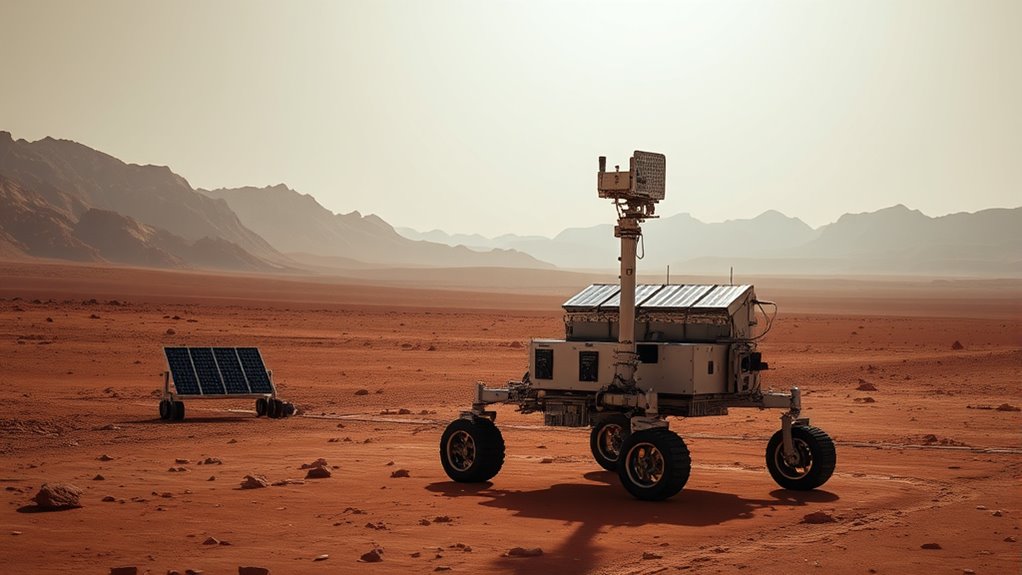

NASA’s latest Mars missions include the Perseverance rover, which has traveled over 20 miles, collected 26 samples, and is supporting the Mars Sample Return campaign to bring these back to Earth. Meanwhile, the ESCAPADE twin satellites, launched in late 2025, are studying Mars’ space weather from orbit. Past missions like Spirit and Opportunity set records and deepened our understanding of water on Mars. If you continue exploring, you’ll uncover more exciting discoveries shaping our future plans for Mars.
Key Takeaways
- Perseverance rover has traveled over 20 miles and collected 26 samples, advancing Mars geology and past life research.
- The Mars Sample Return campaign aims to bring collected samples back to Earth for detailed analysis.
- The ESCAPADE twin satellites, launched in November 2025, study Mars’ space weather and solar wind interactions.
- Past missions like Spirit and Opportunity confirmed liquid water once existed on Mars, revolutionizing planetary exploration.
- Future efforts focus on understanding Mars’ history, supporting human exploration, and fostering international collaborations.
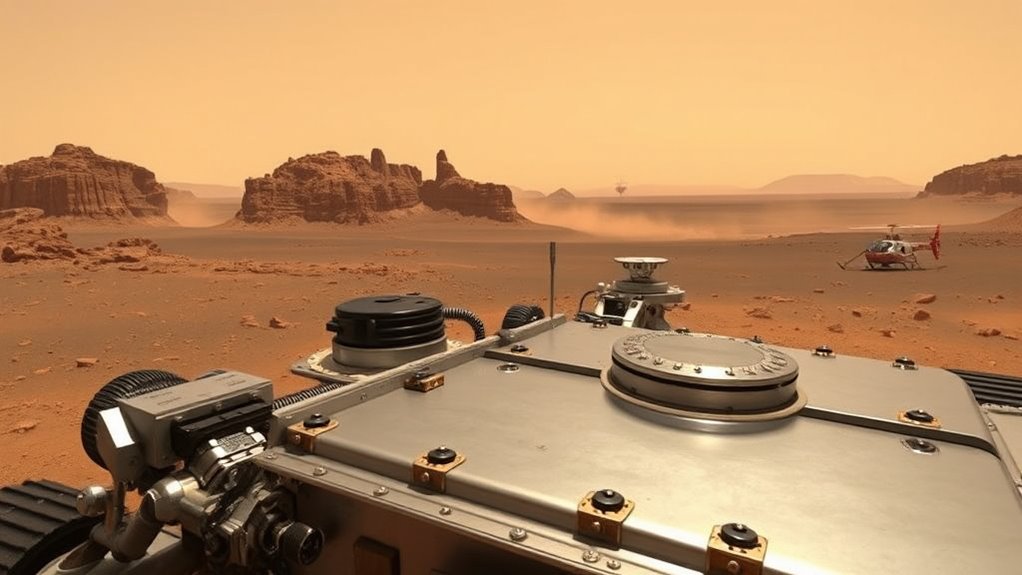
Have you ever wondered how NASA is revealing the secrets of Mars? It’s through a series of groundbreaking missions that push the boundaries of exploration. The Perseverance rover, for example, has traveled over 20.35 miles (32.76 km) as of January 2025, collecting 26 samples of rock, dirt, dust, and even an air sample. After enduring a challenging climb, it recently ascended 1,640 vertical feet (500 meters) to reach the top of Jezero Crater’s rim, entering a new terrain rich with scientific potential. This region is a prime target for studying Mars’ geology and searching for signs of past life. The rover’s ongoing journey is instrumental in the Mars Sample Return campaign, a multi-mission effort that aims to bring carefully selected samples back to Earth. These samples will revolutionize our understanding of Mars and provide detailed insights impossible to gather remotely. It’s a top priority for the planetary science community and a crucial step toward preparing for future human missions. Additionally, the data collected will enhance our understanding of planetary geology and climate history, supporting the development of sustainable exploration strategies.
NASA’s Perseverance explores Mars, collecting samples and climbing new terrains to unlock the planet’s secrets and prepare for future human missions.
Meanwhile, NASA launched the ESCAPADE twin satellites in November 2025. These compact orbiters are designed to study Mars’ space weather, specifically how solar wind interacts with the planet’s magnetic environment. Arriving at Mars by September 2027, they will fly in tandem about 100 miles (160 km) above the surface. Equipped with electrostatic analyzers developed at UC Berkeley, they’ll measure charged particles’ direction and energy, providing a 3D view of solar wind interactions. Their innovative trajectory involves a gravitational detour via a Lagrange point, which enhances launch flexibility and increases the chances of mission success. This approach allows scientists to monitor how Mars’ magnetosphere changes over time and responds to space weather, building on data from the MAVEN orbiter. These missions are part of a broader effort to understand the planet’s magnetic field and its influence on habitability. The knowledge gained from these studies could also inform future planetary defense initiatives by understanding space weather impacts.
Reflecting on past missions, the twin rovers Spirit and Opportunity, launched in 2003, transformed our knowledge of Mars. Spirit landed in Gusev Crater, a probable ancient lakebed, while Opportunity touched down in Meridiani Planum, known for mineral evidence of water. Opportunity holds the record for off-Earth driving at over 28 miles (45 km), and both rovers confirmed that Mars once had liquid water. Their discoveries laid the foundation for more advanced missions like Perseverance. These missions also pioneered imaging techniques that changed global perceptions of the planet.
All these efforts serve core scientific objectives: to search for life, understand Mars’ history, and prepare for human exploration. They leverage technological advances, such as robotic tools and orbital mechanics, to maximize scientific return. The evolving strategy involves international cooperation and private sector involvement, with the long-term goal of establishing a human presence on Mars. Through these missions, NASA continues to reveal the secrets of the Red Planet, bringing us closer to understanding our neighboring world and our place in the solar system.
Top picks for "nasa mars mission"
Open Amazon search results for this keyword.
As an affiliate, we earn on qualifying purchases.
Frequently Asked Questions
How Will Samples From Mars Be Safely Transported Back to Earth?
You’ll see that samples from Mars are transported safely back to Earth through a carefully planned process. The Perseverance rover collects samples and stores them in sealed, contamination-proof tubes. When ready, a lander will launch these containers into orbit, where an ascent vehicle will transfer them to a retrieval orbiter. This orbiter then brings the samples back to Earth, ensuring they stay secure and uncontaminated throughout the journey.
What New Technologies Are Being Tested for Future Crewed Mars Missions?
You’ll see new technologies like advanced robotic tools tested on Mars to support future crewed missions. These include improved landing systems, life support systems, and autonomous robotics that can operate in harsh environments. NASA is also exploring innovative orbital mechanics, like using Lagrange points, to extend mission windows. These advancements aim to make Mars exploration safer, more efficient, and better prepared for humans venturing onto the planet.
How Do the ESCAPADE Satellites Improve Understanding of Mars’ Magnetic Environment?
You know what they say, “seeing is believing.” The ESCAPADE satellites improve your understanding of Mars’ magnetic environment by providing a 3D view of how solar wind interacts with its magnetic field. They fly about 100 miles above the surface, tracking charged particles with advanced analyzers. This helps scientists understand Mars’ space weather, revealing how solar energy influences its atmosphere and climate, ultimately deepening your insight into the planet’s secrets.
What Challenges Are Faced in Landing and Operating Rovers on Mars’ Rugged Terrain?
Landing and operating rovers on Mars’ rugged terrain pose significant challenges. You must navigate uneven surfaces, loose soil, and steep slopes that can trap or damage the rover. Precise landing is critical to avoid hazards, and maintaining communication is tough due to Mars’ distance. You also need robust autonomous systems to handle unexpected obstacles, ensuring the rover can continue its scientific mission despite the harsh environment.
When Can Scientists Expect to Analyze the First Samples Returned From Mars?
You can expect scientists to analyze the first samples from Mars around 2033 or 2034. The Mars Sample Return campaign involves multiple complex steps, including retrieving samples, launching them from Mars, and bringing them to Earth. Each phase takes years of precise planning and execution. Once on Earth, scientists will carefully examine these samples, revealing invaluable insights into Mars’ geology, climate history, and potential habitability, shaping future exploration.
Conclusion
As you follow NASA’s ongoing Mars missions, remember that over 45,000 Martian soil samples have been collected so far. These missions bring us closer to understanding the red planet’s secrets and paving the way for future human exploration. With each new discovery, you’re witnessing history in the making. Stay tuned, because the journey to Mars is just getting more exciting, and the next big breakthrough could be just around the corner.