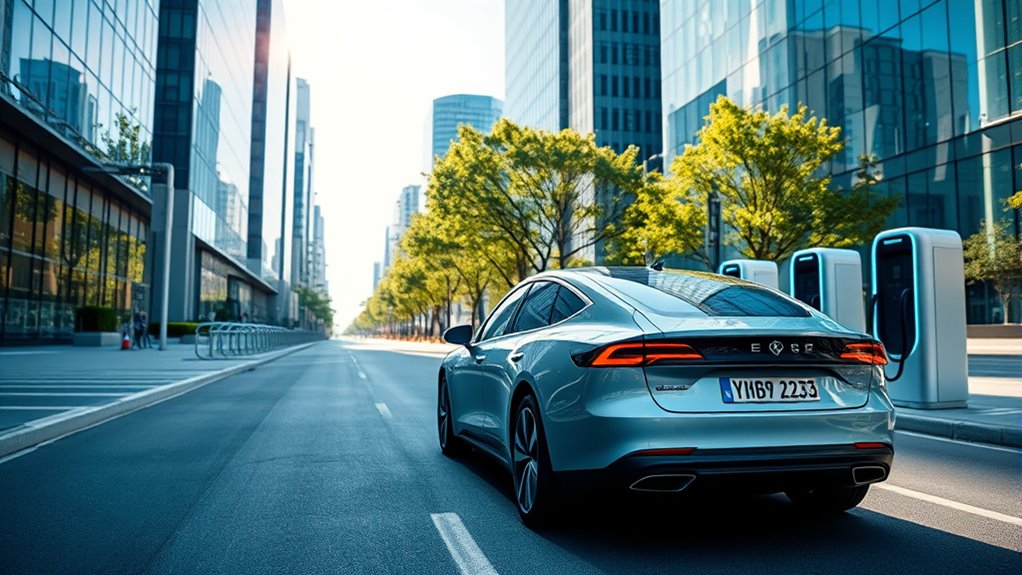

In 2025, the electric vehicle revolution is accelerating fast. You’ll see EVs making up 43% of global auto sales, with China leading at over half of new NEV registrations. Infrastructure improvements, like faster chargers and expanding networks, are making EVs more practical, while prices approach parity with traditional cars. Consumer preferences are shifting towards affordable models, and policies support widespread adoption. Keep exploring to discover how these trends are shaping the future of transportation.
Key Takeaways
- EVs represent 43% of global auto sales in 2025, driven by rapid growth in China, Europe, and emerging markets.
- Mainland China leads with over 57% of BEV registrations, supported by local manufacturing and battery supply chains.
- U.S. EV sales hit 1.2 million in 2025, with a 12% market share, despite the end of federal tax credits.
- Infrastructure advancements include a 33% increase in public charging stations and improved fast-charging speeds.
- Global EV stock is projected to reach nearly 245 million units by 2030, nearing price parity with traditional vehicles.

The electric car revolution is accelerating rapidly worldwide, transforming the automotive landscape in just a few years. In 2025, electrified vehicles make up 43% of global auto sales, a huge leap from only 9% in 2019. You’ll notice that battery electric vehicles (BEVs) now account for 15.7% of global sales, supporting the forecast that total EV sales will surpass 20 million this year—a 25% increase over 2024. This growth isn’t uniform, however. Advanced markets like China and Europe lead the charge, while others, such as the U.S., lag behind due to various barriers. Emerging markets are catching up quickly, with countries like Thailand, India, and Brazil reaching notable adoption rates, driven by affordable models tailored to local needs.
Mainland China dominates the global scene, with NEVs making up half of all new car sales in 2025. For the first time, China’s NEV sales surpass internal combustion engine vehicles, buoyed by a vast local supply chain, gigascale battery production, and a wide array of domestic models. China also accounts for over 57% of all global BEV registrations in early 2025. Meanwhile, Europe holds a respectable share, with about 23% of new car sales being NEVs and a 22% share of global BEV sales. Norway leads globally in EV adoption, with policies and infrastructure strongly supporting high market shares. The U.S. trails considerably, with only 7.5% of new sales being BEVs and 9% NEVs, reflecting slower growth due to tariffs, infrastructure gaps, and pricing concerns.
Despite these hurdles, the U.S. market shows resilience. In the first three quarters of 2025, U.S. EV sales hit a record 1.2 million, capturing nearly 12% of the market in Q3. Even with the end of federal tax credits in September, EV sales continued to expand, and penetration in some areas reached 14% by September. Most U.S. EV buyers opt for models priced under $50,000, making electric vehicles more accessible to the mainstream. Still, concerns about charging infrastructure and vehicle costs keep some consumers hesitant. Hybrids are filling the gap in markets where pure EVs face barriers, especially in the U.S. Furthermore, advances in technology and infrastructure play pivotal roles. The average EV range increased by 4% to nearly 300 miles, easing range anxiety. Fast charging speeds improved by 7%, supporting longer trips and quick top-ups. Public charging infrastructure grew by over 33%, with 17,000 new ports added, outpacing EV fleet growth in many regions. Countries with dense, mature charging networks, like China and parts of Europe, see faster adoption. However, gaps remain in the U.S. and emerging markets, where infrastructure development isn’t keeping pace. Additionally, the global supply chain strengths—particularly in battery manufacturing—are crucial for maintaining momentum and reducing vehicle costs.
Supply chain strengths also influence market dynamics. China benefits from localized manufacturing and large-scale battery production, enabling aggressive model rollout and cost reductions. In the U.S., over 100 EV models are now available across segments, including pickups and SUVs, providing consumers with more choices. Competitive pricing, incentives, and robust supply chains have become key drivers for broader adoption, helping EVs inch closer to price parity with traditional vehicles. As policies support continued growth, the outlook for EV adoption remains optimistic, with projections indicating that by 2030, nearly 245 million EVs will be on the road globally.
Top picks for "electric revolution trend"
Open Amazon search results for this keyword.
As an affiliate, we earn on qualifying purchases.
Frequently Asked Questions
How Will EV Charging Infrastructure EVolve in Rural Areas?
In rural areas, EV charging infrastructure will grow steadily, but at a slower pace than urban centers. You’ll see more public charging stations, including fast chargers, to address range anxiety. Governments and private companies will collaborate to expand coverage, focusing on installing chargers along major highways and in community hubs. As technology advances and costs decrease, expect more accessible and reliable charging options, making EV ownership more practical for rural residents.
What Are the Long-Term Cost Benefits of EV Ownership?
Think of owning an EV like planting a seed for the future—you’ll reap long-term benefits. Over time, you’ll save on fuel costs, as electricity is cheaper than gas, and enjoy lower maintenance expenses since EVs have fewer moving parts. Incentives and falling battery prices make initial costs more manageable, leading to savings that grow with your vehicle’s lifespan, making EV ownership a smart, cost-effective choice in the long run.
How Will Battery Recycling Impact EV Sustainability?
Battery recycling will substantially boost EV sustainability by reducing the need for new raw materials, lowering environmental impact, and cutting costs. When you recycle batteries, you help minimize waste and preserve valuable resources like lithium and cobalt. This process promotes a circular economy, making EVs more affordable and eco-friendly over time. As recycling infrastructure improves, you’ll see cleaner, more sustainable vehicles, supporting global efforts to combat climate change and promote greener transportation.
What Role Will Autonomous Driving Play in EV Adoption?
Autonomous driving will act as the engine propelling EV adoption forward. It enhances safety, convenience, and efficiency, making electric vehicles more attractive to consumers. When self-driving tech seamlessly integrates with EVs, you’ll find it easier to choose electric, especially for long commutes or fleet use. This technological synergy reduces barriers, accelerates adoption, and transforms electric cars from simple transport to intelligent mobility solutions, driving the future of sustainable transportation.
How Are Raw Material Shortages Affecting EV Production?
You’ll find raw material shortages slowing EV production, especially for batteries. Limited supplies of lithium, cobalt, and nickel cause delays and higher costs, making it harder for manufacturers to meet demand. These shortages also push prices up, affecting affordability and slowing growth in some markets. To stay competitive, you’ll need to watch how supply chains adapt and how new sourcing strategies develop to overcome these material constraints.
Conclusion
As you consider the future, imagine yourself driving a sleek electric car through a city powered by clean energy. With increasing adoption and innovative policies, this shift isn’t just a trend—it’s a revolution. Take, for example, a small town that swapped its fleet to EVs, dramatically reducing emissions and costs. By 2025, you’ll likely see more of these stories, showing how embracing electric vehicles can transform communities and protect our planet for generations to come.