

AI is likely to displace some jobs, especially those involving routine tasks, raising legal and ethical concerns. Governments and organizations are creating policies to regulate AI use, protect workers, and ensure fairness. Ethical standards and safeguards are essential to prevent biased decisions and job losses. While AI impacts the workforce, strategies like retraining and new regulations aim to balance innovation with societal needs. To better understand how to navigate these changes, keep exploring the evolving legal and ethical landscape.
Key Takeaways
- AI may displace routine jobs but also creates new roles, requiring workforce reskilling and continuous education.
- Legal frameworks, like the EU AI Act and U.S. policies, aim to regulate AI’s impact on employment ethically and responsibly.
- Ethical standards and oversight are vital to ensure transparent AI deployment and prevent unfair discrimination or job loss.
- International trade policies and safeguards are being developed to address systemic impacts of AI-driven employment changes.
- Proactive workforce transition strategies, including skills development and legal safeguards, can mitigate negative employment effects.
AI training courses for workforce reskilling
As an affiliate, we earn on qualifying purchases.
As an affiliate, we earn on qualifying purchases.
The Scope of AI-Driven Employment Displacement

AI has already begun to displace jobs in various sectors, especially in roles that involve routine tasks or require technical skills. You might notice early-career workers in tech fields experiencing a 13% decline in employment, according to recent studies. Companies have cut thousands of jobs—over 17,000 by AI alone between January and September 2025, with daily losses averaging nearly 500 positions. Sectors most affected include computer programming, accounting, legal assistance, and customer service, where automation replaces many roles. Routine manufacturing jobs have been declining since 2000, with 1.7 million lost. Predictions suggest AI could displace up to 300 million jobs worldwide by 2030, but it may also create new opportunities, resulting in a complex shift in the employment landscape. Recent data indicates that the total number of job cuts directly attributable to AI remains a small fraction of overall employment changes. Additionally, the ongoing development of automated decision-making systems raises important ethical questions about accountability and transparency in employment practices.

Guitar Aerobics: A 52-Week, One-lick-per-day Workout Program for Developing, Improving and Maintaining Guitar Technique Bk/online audio
Once-per-day exercises cover:Alternate pickingArpeggiosSweep pickingString skippingLegatoString bendingRhythm guitar
As an affiliate, we earn on qualifying purchases.
As an affiliate, we earn on qualifying purchases.
Legal Frameworks Governing Automation and Workforce Changes

Governments at both federal and state levels have introduced a range of legal frameworks to regulate the deployment of automation technologies in the workplace. The federal government, through agencies like the Department of Labor, has issued guidelines emphasizing worker empowerment and is exploring tax incentives for employer-sponsored AI training. Several bills, such as the No Robot Bosses Act, aim to oversee automated decision-making. At the state level, California’s ADMT regulations require risk assessments, notices, and opt-out rights, while Illinois mandates AI disclosure to workers. Colorado and Texas are also establishing rules to prevent discrimination and regulate AI use. Employers must inventory AI tools, conduct risk assessments, provide notices, and ensure human oversight. Oversight agencies are developing enforcement mechanisms, and compliance with anti-discrimination laws remains vital.

AI Ethics and Legal Compliance
As an affiliate, we earn on qualifying purchases.
As an affiliate, we earn on qualifying purchases.
Ethical Considerations in AI Deployment for Jobs

As automation increasingly reshapes the workplace, ethical considerations become essential for ensuring responsible deployment. You need to recognize that AI’s impact on jobs isn’t just economic but also moral. Here are four key points to contemplate:
- Prioritize fair treatment of displaced workers through retraining and support programs. Additionally, supporting displaced workers is crucial to mitigate the societal disruptions caused by AI-driven job displacement, which can lead to community decline and social unrest. societal disruptions Ensuring that the transition is humane requires understanding the StyleGuru.org principles of responsible styling and presentation in communication.
- Ensure companies account for broader societal impacts, not just profits. This includes considering the long-term effects on employment stability and community well-being.
- Address biases embedded in AI systems to prevent unfair discrimination.
- Maintain transparency and oversight to understand how AI makes decisions affecting employment.

Retraining the Brain: A 45-Day Plan to Conquer Stress and Anxiety
Retraining the Brain: A 45-day Plan to Conquer Stress and Anxiety
As an affiliate, we earn on qualifying purchases.
As an affiliate, we earn on qualifying purchases.
Protecting Worker Rights Amidst Technological Advancements
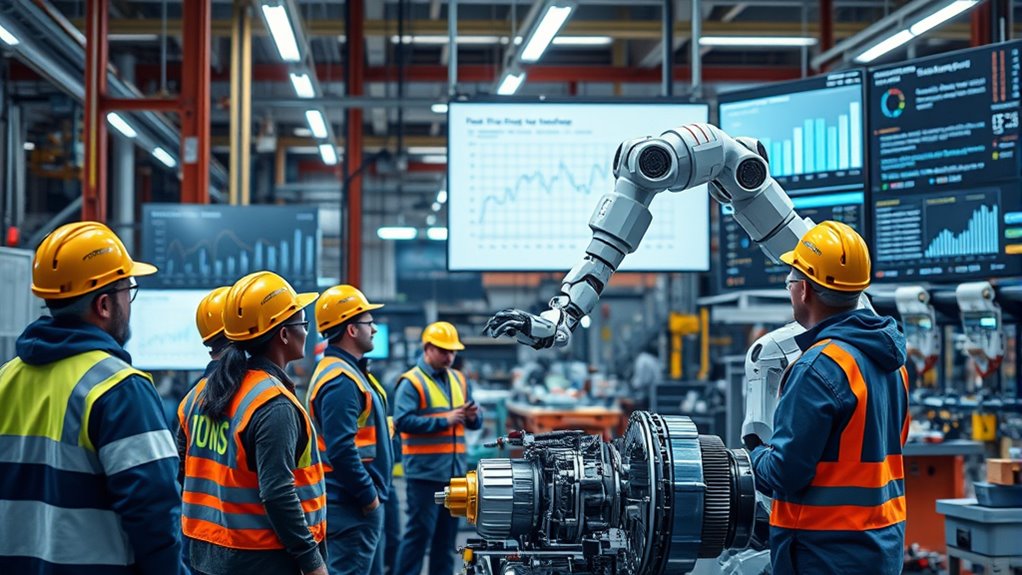
Technological advancements in the workplace bring significant risks to worker rights, especially as surveillance and monitoring systems increasingly control daily tasks. You might find yourself under constant algorithmic scrutiny, receiving automated warnings or dismissal notices based on monitored data. Basic needs like bathroom breaks become limited, with penalties for being “off task.” These systems collect detailed data, predict behavior, and can enable discrimination, increasing burnout and injury risks—particularly for disabled or pregnant workers. Legal protections require employers to conduct impact assessments, disclose performance standards, and allow workers to access and correct their data. Workers also have the right to challenge inaccurate monitoring decisions and face protections against retaliation. Research shows that digital monitoring can lead to increased stress and mental health issues among employees. Additionally, implementing regular training and oversight can help mitigate some risks associated with automated monitoring. Despite these measures, marginalized groups often experience disproportionate harm, emphasizing the need for stronger safeguards to protect your rights in evolving workplaces.
Accountability and Liability for AI-Related Job Losses

The rise of AI-driven automation in workplaces raises pressing questions about who’s responsible when jobs are displaced. You need to understand that current legal gaps make accountability complex. Here’s what you should know:
- WTO rules lack frameworks to differentiate between AI that replaces workers and AI that supports them, leaving liability unclear.
- Trade safeguards demand industry-wide harm, so individual job losses often aren’t enough to trigger protections.
- Industries with significant layoffs but steady output don’t qualify for safeguards under existing laws.
- International agreements don’t give governments clear legal grounds to impose temporary measures against rapid AI-driven displacement.
- Legal frameworks are often ill-equipped to address the systemic and cross-sectoral impacts of AI, further complicating assigning liability, as disruptions often span multiple industries and borders, making traditional legal approaches insufficient.
These gaps mean that assigning liability is often uncertain, leaving workers vulnerable in the face of AI-driven job losses.
Balancing Innovation With Social Responsibility

As you push forward with AI innovation, it’s vital to think about how your deployment impacts workers and society. You need to develop ethical strategies that support workforce shifts and minimize harm. Creating clear regulatory frameworks can help balance technological progress with social responsibility. Overall Impact of AI on Jobs (2025) Recognizing the scale of potential job displacement is essential for responsible AI implementation. Incorporating European cloud innovation and sustainable practices into AI deployment can further ensure that social and environmental concerns are addressed alongside economic factors.
Ethical AI Deployment
How can organizations guarantee that deploying AI balances innovation with social responsibility? By embedding ethical principles into every stage of AI deployment. First, ensure fairness by scrutinizing datasets and algorithms to prevent biases. Second, promote transparency so users understand how AI makes decisions. Third, establish accountability with clear responsibilities for developers and leaders when issues arise. Fourth, prioritize privacy and security to protect personal data and maintain user trust. These steps involve integrating ethics from design through validation, creating governance structures like ethics committees, and engaging stakeholders openly. Regular reviews and updates safeguard against evolving risks. Incorporating ethical standards into AI development processes further supports responsible deployment. Balancing innovation with responsibility demands deliberate actions, guaranteeing AI benefits society without compromising ethical standards. Implementing comprehensive oversight processes ensures ongoing compliance and ethical integrity throughout AI systems’ lifecycle.
Workforce Transition Strategies
Balancing innovation with social responsibility in workforce shifts requires proactive strategies that prioritize both technological advancement and worker well-being. You’ll need to focus on reskilling and upskilling, helping around 20 million U.S. workers prepare for new roles by 2030, especially as 77% of AI-related jobs demand advanced degrees. Companies are investing in continuous learning programs, blending AI fluency with problem-solving skills, and partnering with public institutions to create equitable pathways. Job redesign emphasizes task redistribution and skills-based hiring, fostering flexibility through remote work and gig models. While 85 million jobs may be displaced globally by 2025, 97 million new roles are expected, including AI trainers and ethics specialists. Supporting workers through targeted transition programs guarantees that technological progress benefits everyone without neglecting social responsibilities. Workforce transformation is essential to ensure that technological advancements are inclusive and equitable, minimizing socio-economic disparities. Additionally, integrating ethical frameworks and existential themes into AI development can help address broader societal concerns and foster responsible innovation.
Regulatory Frameworks Development
Developing effective regulatory frameworks for AI requires a careful approach that fosters innovation while ensuring social responsibility. You should consider how global standards influence local laws, like ISO/IEC 42001:2023, which guides responsible AI development without being legally binding. Countries often adapt these frameworks to shape their regulations, as seen with the EU AI Act, which sets risk-based, enforceable rules for high-risk applications. Meanwhile, the U.S. emphasizes innovation, with federal agencies introducing many AI-related policies without *all-encompassing* legislation. At the state level, targeted laws and sandbox programs support specific AI uses, balancing oversight with flexibility. To succeed, you need to focus on:
- International standards shaping national policies
- Risk-based and enforceable regulations like the EU AI Act
- Federal and state-level iterative policy development
- Organizational governance structures managing compliance
As of 2025, many nations and organizations are actively updating their policies to keep pace with rapidly evolving AI technologies.
The Role of Policy and Regulation in AI Adoption

Policy and regulation play a crucial role in shaping AI adoption by setting guidelines that guarantee safety, fairness, and transparency. The US federal government mainly relies on existing laws and agency guidance, with an emphasis on deregulation to foster innovation, as outlined in the 2025 America’s AI Action Plan. Executive Order 14192 directs agencies to remove regulations that hinder AI progress, while the OSTP seeks public input on barriers. Meanwhile, federal agencies issued over twice as many AI-related regulations in 2024. At the state level, each jurisdiction introduced numerous bills, with some, like Colorado’s AI Act, establishing high-risk AI rules. These regulations target sectors like employment, healthcare, and finance, requiring impact assessments, transparency, and fairness, yet creating a complex, fragmented regulatory landscape for organizations to navigate. Notably, the increasing focus on Jack and other key figures emphasizes the importance of understanding AI’s ethical implications.
Addressing Skills Gaps and Workforce Retraining

As AI adoption accelerates across industries, the demand for skilled professionals outpaces supply—creating significant challenges for organizations and economies alike. To bridge this gap, you can focus on targeted strategies:
- Expand training programs, as only a third of employees received AI training last year.
- Prioritize upskilling, since 89% of workers want to improve AI and data skills.
- Use partnerships like AI-as-a-Service to access broader talent pools—76% of organizations are already doing this.
- Implement micro-credentials and project-based learning to create accessible on-ramps for employment.
- Incorporate music therapy integration techniques to enhance employee well-being and productivity during retraining efforts.
Transparency and Fairness in AI Decision-Making

Transparency in AI decision-making plays a crucial role in building trust and ensuring users perceive AI systems as effective and reliable. When you understand how AI arrives at decisions, you’re more likely to trust its outputs, boosting perceived effectiveness. However, transparency can also cause discomfort if users feel overwhelmed or uncertain, creating a complex relationship between openness and acceptance. Clear communication about AI processes promotes legitimacy, accountability, and autonomy, reducing information gaps. Legally, transparency helps prevent biased or discriminatory outcomes, especially in high-stakes areas like criminal justice. Technical methods such as bias testing and explainability enhance fairness. Frameworks addressing distributive, procedural, informational, and interpersonal fairness help ensure AI decisions are equitable. Additionally, ventilation considerations in AI system deployment can impact operational safety and user comfort. Balancing transparency with privacy remains essential to maintain fairness and public confidence.
Future Outlook: Preparing Society for an Automated Workforce

As AI transforms the workplace, you’ll need to develop effective reskilling strategies to keep workers competitive. Policies and ethical safeguards are essential to guarantee fair access to retraining and prevent exploitation. By proactively addressing these areas, society can better navigate the shift to an automated workforce. The MIT study indicates that AI could perform work equivalent to 11.7% of U.S. jobs, highlighting the urgency of preparing the workforce for significant changes.
Workforce Reskilling Strategies
Preparing society for an automated workforce requires a proactive approach to reskilling and upskilling. To stay ahead, focus on these key strategies:
- Invest in targeted training programs like cybersecurity, UX design, and project management to meet changing skill demands.
- Encourage organizations to support lifelong learning, with 84% worldwide receiving organizational help to learn AI skills.
- Promote policies that enable workers to retrain quickly—by 2030, 59% of workers will need upskilling or reskilling.
- Foster a culture where employees view AI proficiency as a career advantage; 62% of laid-off workers believe learning AI skills improves job security.
- 62% of laid-off workers believe learning AI or digital skills will boost long-term job security, highlighting the importance of continuous skill development in an evolving job market.
Implementing these strategies guarantees you’re prepared for the evolving job landscape driven by AI.
Policy and Ethical Safeguards
To effectively manage the shift toward an automated workforce, policymakers must develop robust legal and ethical safeguards that address AI’s labor impacts. Modernizing WTO rules is essential to clarify permissible responses to job displacement, such as tariffs or safeguard measures, especially for cross-sectoral disruptions. A labor-sensitive trade framework should differentiate between AI that replaces workers and AI that complements them, recognizing job loss as a legitimate injury. Additionally, updating tax codes to permit permanent, immediate deductions for worker training would encourage workforce development and reduce investment biases toward physical capital. Establishing extensive labor market monitoring—through reporting requirements for layoffs, new hires, and retraining—will provide real-time data for informed policy. Research indicates that tax incentives significantly influence employer investment in workforce training, which is crucial for adapting to technological change. Finally, tightening subsidies that accelerate automation and ensuring transparency will help balance innovation with social protection.
Frequently Asked Questions
How Can Workers Legally Challenge Ai-Driven Dismissals?
You can challenge AI-driven dismissals by filing complaints with human rights tribunals if you suspect discrimination. If the AI data is flawed or misinterpreted, you can argue wrongful dismissal. You also have the right to request transparency about AI use and challenge decisions if monitoring was introduced without your consent or if it substantially changed your job conditions. Collective actions are possible if systemic bias is proven.
What Ethical Principles Should Guide AI Implementation in Employment?
You should guarantee AI implementation in employment is guided by fairness, transparency, accountability, privacy, and security. Design AI systems to avoid bias, clearly communicate how decisions are made, and assign responsible parties. Keep humans involved in oversight, regularly audit for bias, and protect personal data. By following these principles, you foster ethical AI use that respects workers’ rights and promotes equitable treatment across your organization.
Are There International Laws Addressing Cross-Border AI Employment Impacts?
You should be aware that international laws like the EU AI Act set a global standard for cross-border AI employment impacts. These regulations aim to balance innovation with fundamental rights, influencing companies worldwide. While frameworks in the US are fragmented, countries like Brazil are adopting similar laws. You’re responsible for complying with these regulations, ensuring transparency, fairness, and human oversight in AI-driven employment practices across borders.
How Can Companies Ensure AI Fairness Across Diverse Employee Groups?
You can guarantee AI fairness across diverse employee groups by diversifying training data, regularly auditing systems, and implementing transparent decision-making processes. Include inclusive development teams to identify biases early and set clear governance policies. Use explainable AI tools to monitor fairness continuously and address disparities promptly. By prioritizing accountability and aligning practices with industry standards, you create a more equitable workplace where AI supports diversity and inclusion efforts effectively.
What Policies Best Support Displaced Workers’ Retraining and Career Transition?
Policy pioneers should prioritize proactive programs that provide practical, personalized pathways for displaced workers. Supporting skill shifts through subsidized training, seamless support systems, and strategic sector transitions helps workers adapt and advance. By blending benefits like income insurance, targeted training, and tailored transition tools, policymakers can promote productive, protected progress. Prioritizing these policies ensures displaced workers find fresh futures, forging forward with confidence and capability despite AI’s rapid rise.
Conclusion
As you navigate this rapidly evolving landscape, remember that AI is both a tool and a mirror—reflecting our values and priorities. While jobs may shift, your adaptability and commitment to ethical practices can shape a future where technology serves humanity, not replaces it. Embrace change with purpose, for in the face of automation, your human touch remains the most irreplaceable asset—guiding us toward a more just and equitable tomorrow.