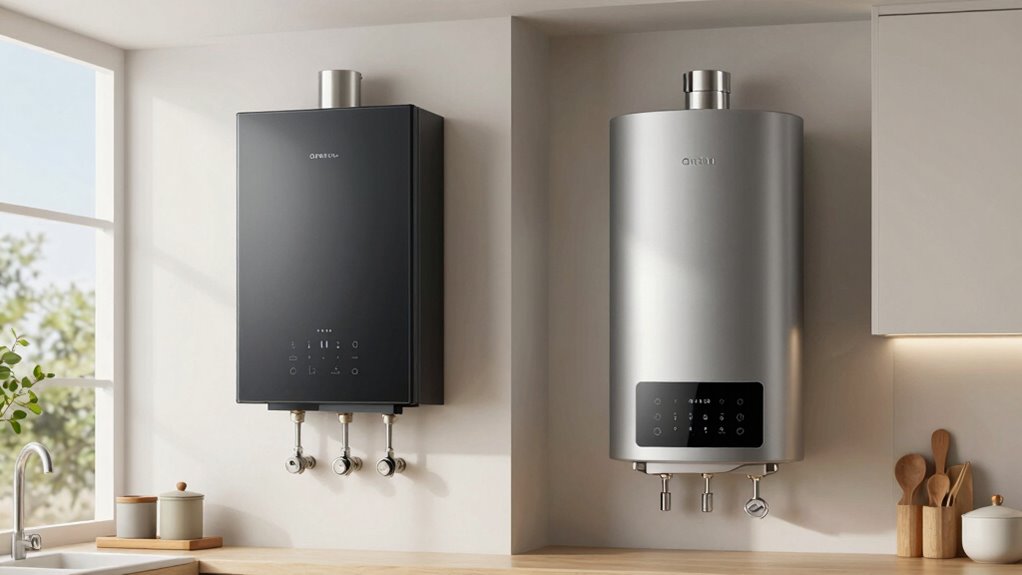

If you’re choosing between tankless and tank water heaters for your family, consider your hot water needs and budget. Tankless heaters heat water on demand, saving energy and space, but they have higher upfront costs and may require multiple units for larger households. Traditional tanks are cheaper and simpler to install, but they waste more energy maintaining stored water. To learn more about which option suits your household best, explore the details below.

Get the little things that make your day delivered free with Prime
- Fast, free delivery on millions of items
- Prime Video, Amazon Music and more included
- Member-only deals all year
Key Takeaways
- Tankless water heaters provide on-demand hot water, ideal for energy savings and reducing standby heat loss in families.
- Traditional tank heaters are generally less expensive upfront and simpler to install, suitable for smaller budgets.
- Larger families may require multiple tankless units or higher-capacity tanks to meet peak hot water demands.
- Long-term savings from energy efficiency can offset higher initial costs of tankless systems over time.
- System choice depends on household size, hot water needs, and willingness to invest in installation and technology.
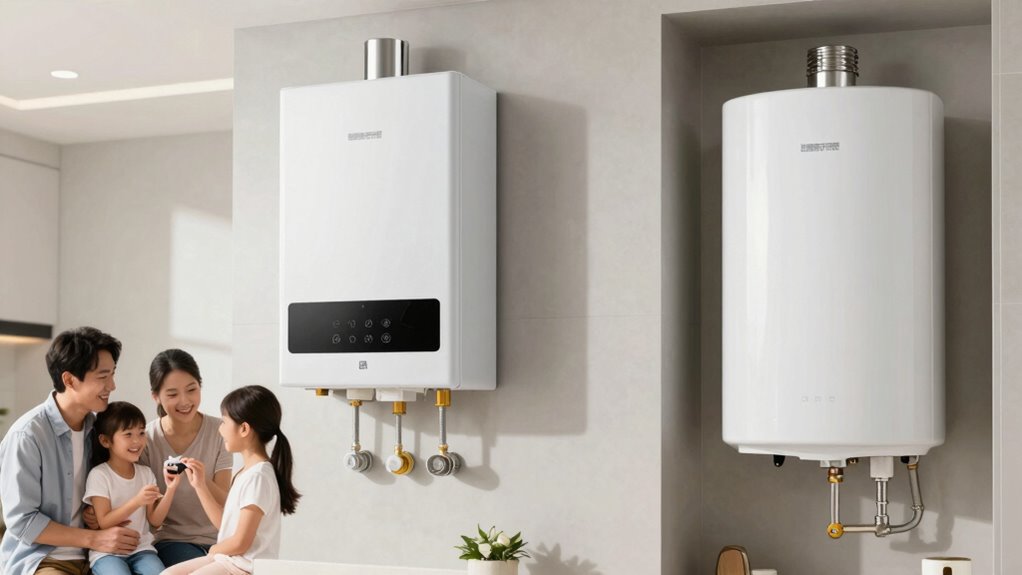
Choosing between tankless and tank water heaters can considerably impact your family’s daily routines and energy bills. When deciding, one of the key factors to evaluate is energy efficiency. Tankless water heaters, also known as on-demand systems, heat water only when you need it. This means they don’t store hot water in a tank, so you avoid standby heat loss—where stored hot water cools down and requires reheating. As a result, tankless models often consume less energy over time, helping you save on utility bills. On the other hand, traditional tank water heaters keep a large volume of water heated continuously, which can lead to higher energy consumption, especially if the tank isn’t well-insulated. If your family uses hot water in bursts or for short periods, a tankless system can be more efficient, providing hot water instantly without wasting energy maintaining a tank’s temperature.
Tankless heaters save energy by heating water only on demand, reducing standby heat loss and utility bills.
However, the decision isn’t solely about energy efficiency. Installation costs are another critical factor to weigh. Tankless water heaters typically come with higher upfront costs, both for the unit itself and for installation. They require specialized venting and sometimes additional electrical work, which can increase installation expenses. Conversely, traditional tank water heaters are generally less expensive to purchase and install because they’re more straightforward systems that many plumbers are familiar with. If your budget is tight initially, a tank model might seem more attractive, but keep in mind that ongoing energy costs could offset that initial saving over time. Additionally, system scalability is an important consideration, especially for larger households with higher hot water demands. Considering technological advancements can also help you make a more informed choice, as newer models often feature improved efficiency and durability.
Further, understanding system capacity is vital, as larger families may need higher-capacity models or multiple units to meet peak usage. Your household size and hot water demand also play a role in this decision. Larger families often need a higher capacity tank or multiple tankless units to meet peak usage, which can influence both initial costs and long-term savings. Tankless systems, especially those designed for whole-house use, can be scaled with additional units, but this setup can become complex and more costly. On the other hand, a well-sized tank water heater can supply enough hot water for a larger family, but you might face higher energy consumption and potential risks of running out of hot water during heavy use.
Ultimately, choosing between a tankless and a traditional tank water heater involves balancing upfront costs, ongoing energy savings, household hot water needs, and your long-term plans. If energy efficiency and reduced utility bills appeal to you, and you’re willing to invest more initially, a tankless system might be the better choice. But if you prefer lower installation costs and simpler setup, a traditional tank heater could serve your family’s needs effectively.
tankless water heater for large families
As an affiliate, we earn on qualifying purchases.
As an affiliate, we earn on qualifying purchases.
Frequently Asked Questions
Which Type Has Lower Long-Term Operating Costs?
Tankless water heaters generally have lower long-term operating costs because they’re more energy-efficient, using only energy when you need hot water. Although the initial investment is higher, you save money on energy bills over time. Tankless systems last longer and require less maintenance, which also cuts costs. So, if you’re looking for a more economical choice in the long run, a tankless water heater is the better option.
How Do Installation Requirements Differ Between the Two?
Did you know that tankless water heaters require up to 30% more complex installation? Their installation complexity often involves upgrading your home’s gas lines, venting, and electrical systems, making it more involved than traditional tank models. However, they excel in space efficiency, fitting into small areas. Tank heaters are simpler to install but take up more space. You need to weigh installation difficulty against your available space when choosing.
Are Tankless Heaters Suitable for Very Cold Climates?
Tankless heaters can be suitable for very cold climates if you consider climate considerations and guarantee proper sizing. In colder regions, you might need a unit with a higher flow rate or a preheating system to maintain water temperature. While they’re energy-efficient, their performance depends on climate conditions. Proper installation and choosing the right model are essential to make certain of reliable hot water supply in extreme cold weather.
What Is the Typical Lifespan of Each Heater Type?
You’ll find that tankless water heaters typically last around 20 years, while tank models usually last about 10-15 years. Both types are quite energy-efficient, with tankless units offering better efficiency since they heat water on demand. Considering environmental impact, tankless heaters produce fewer emissions over their lifespan, making them a more eco-friendly choice. Regular maintenance can extend these lifespans and help you maximize energy savings.
Do Tankless Systems Require More Maintenance?
Imagine your family relies on a tankless system, and suddenly, hot water runs out during a busy morning. You might think it needs more maintenance, but actually, tankless systems typically require less maintenance frequency compared to tank models. They’re energy efficient and last longer, but it’s wise to regularly flush them to prevent mineral buildup. Proper upkeep guarantees peak performance and prevents costly repairs down the line.
energy-efficient tank water heater
As an affiliate, we earn on qualifying purchases.
As an affiliate, we earn on qualifying purchases.
Conclusion
Choosing between tankless and tank water heaters is like picking the right tool for a job—you want efficiency and reliability. If your family values endless hot water and space-saving design, a tankless heater might be your best bet. However, if upfront costs and simplicity matter more, a tank model could serve you well. Remember, the right choice depends on your family’s needs—think of it as finding the perfect puzzle piece to complete your home.
As an affiliate, we earn on qualifying purchases.
high capacity traditional water heater
As an affiliate, we earn on qualifying purchases.
As an affiliate, we earn on qualifying purchases.
Columbus Day / Indigenous Peoples' Day Picks
long weekend sales
As an affiliate, we earn on qualifying purchases.