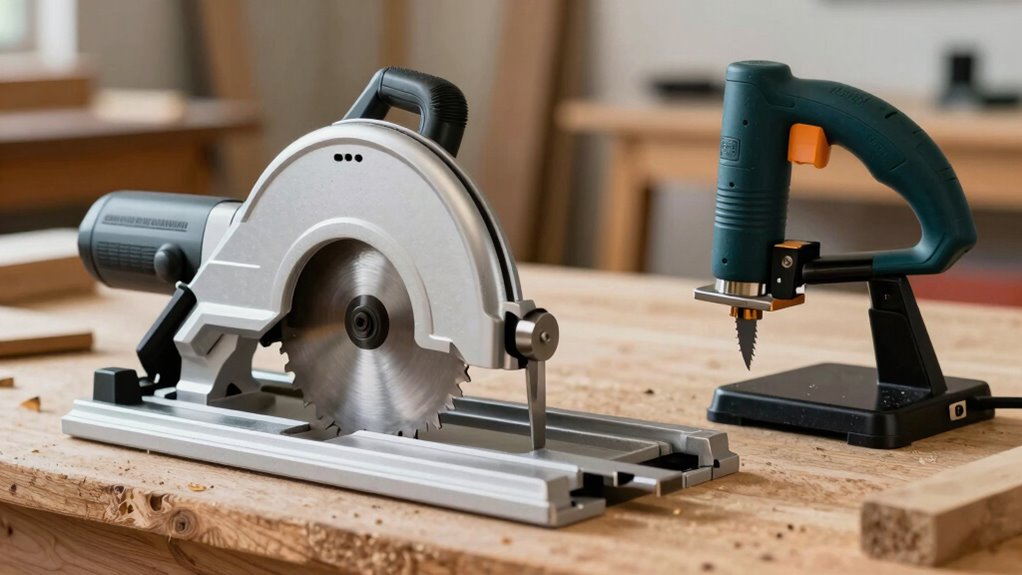

For DIY projects, a table saw is great for ripping large sheets and making long, straight cuts, while a miter saw excels at precise crosscuts and angled cuts for framing or molding. The table saw offers stability and can handle bigger tasks, but it tends to be louder and requires more safety precautions. The miter saw is quieter, easier to control, and safer for smaller, detailed cuts. Keep exploring to find out which fits your project needs best.

Get the little things that make your day delivered free — and shop member deals
- Fast, free delivery on millions of items
- Access to Prime Big Deal Days deals on October 6–7
- Prime Video, Amazon Music and more included
Key Takeaways
- Choose a table saw for ripping large sheets and making long, straight cuts; opt for a miter saw for precise crosscuts and angled cuts.
- Miter saws are safer and easier to control, making them ideal for smaller, detailed DIY projects.
- Use a table saw for projects requiring high capacity and stability when cutting big panels or wide boards.
- Miter saws produce less noise and are more suitable for indoor use and shared workspaces.
- Consider safety features and noise levels to select the best saw based on your workspace and project complexity.
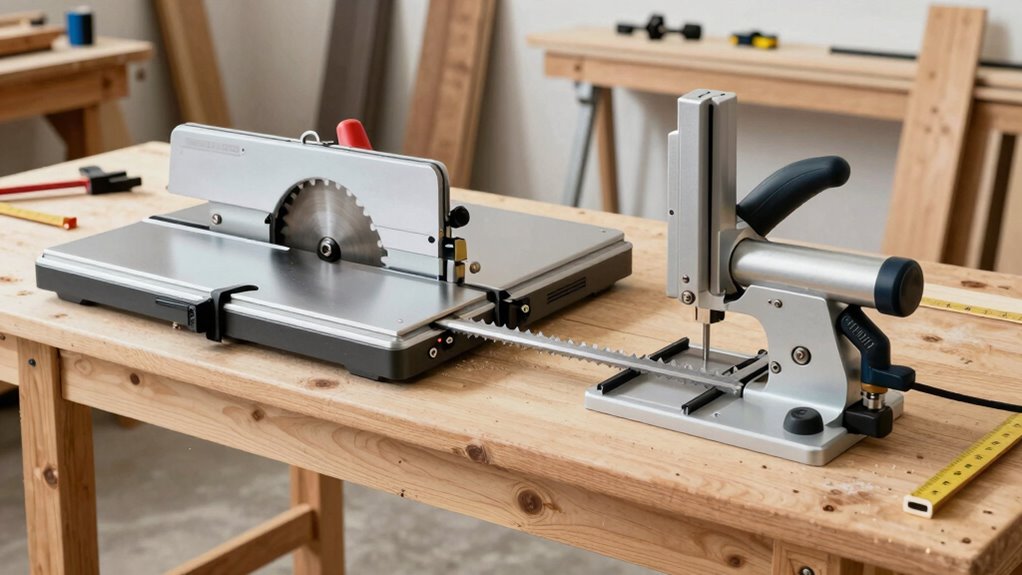
When it comes to DIY woodworking projects, choosing the right saw can make all the difference in your results and efficiency. Two popular options are the table saw and the miter saw, each suited to different tasks. Understanding their strengths and limitations helps you decide which one suits your projects best.
Choosing the right saw enhances your woodworking results and efficiency, as table and miter saws serve different project needs.
A table saw is a versatile tool that works well for ripping large sheets of wood and making long, straight cuts. It provides stability and precision, especially when you need consistent cuts across wide boards. Safety should be a priority with any saw, so focus on blade safety. Modern table saws come with safety features like blade guards, riving knives, and flesh detection systems, making it easier to work safely. Noise levels are also a consideration; table saws tend to produce a high volume of noise, which can be tiring during extended use. Using hearing protection is essential, and choosing a quieter model or installing noise-dampening accessories can help mitigate the sound.
On the other hand, a miter saw excels at crosscuts and angled cuts, making it ideal for framing, molding, and trim work. Its design allows you to make precise, repeatable cuts with minimal effort. Because the blade is stationary and the workpiece moves, it reduces the risk of kickback and improves safety. Blade safety is still important, but miter saws are generally easier to control, especially for smaller projects. Noise levels are lower compared to a table saw, which makes it more suitable for indoor use or shared workspaces where noise might be a concern. The limited cutting capacity means it’s not the best choice for ripping large panels or doing long cuts, but for precise crosscuts and angles, it’s unbeatable. Additionally, understanding the safety features of each saw helps ensure safer operation and reduces the risk of injury.
As an affiliate, we earn on qualifying purchases.
Frequently Asked Questions
Which Saw Is Safer for Beginners?
The miter saw is generally safer for beginners because it offers better safety considerations, such as a enclosed blade and easier handling. For beginner tips, always wear safety gear and keep your hands away from the blade. Use clamps to secure your workpiece and take your time. A table saw requires more experience and safety precautions, so it’s better to start with a miter saw to build confidence and skills.
Can I Use a Miter Saw for Ripping?
You shouldn’t use a miter saw for ripping because it’s not designed for that task. Ripping requires a large, stable cut, which a table saw handles better. With a miter saw, blade alignment isn’t optimized for long cuts, and dust collection may be less effective, causing safety issues. For ripping, stick to a table saw to guarantee precise cuts and safety.
How Much Space Do These Saws Require?
You need about 3 to 4 feet of space for a miter saw and around 4 to 6 feet for a table saw, depending on their sizes. Make sure there’s enough room for blade alignment adjustments and dust collection systems to operate efficiently. Keep in mind, a cluttered workspace hampers safety and precision. Clear the area regularly to maintain ideal dust collection and guarantee smooth, accurate cuts.
Are Cordless Options Available for Either Saw?
Yes, cordless options are available for both saws. You can find battery-compatible models that allow you to swap out batteries easily, offering portability and convenience. For maintenance, blade replacement is straightforward, making it simple to keep your saw in top condition. These cordless saws are perfect if you want mobility without sacrificing power, and they work well for DIY projects around the house or on the go.
Which Saw Is Better for Cutting Thick Hardwoods?
For cutting thick hardwoods, a table saw generally performs better because of its blade durability and cutting speed. Its larger, more powerful blade can handle dense materials more efficiently, providing cleaner cuts and less wear over time. A miter saw isn’t ideal for thick hardwoods due to limited blade size and slower cutting speed. So, if you frequently work with thick hardwoods, a sturdy table saw is your best bet.
precision miter saw for DIY projects
As an affiliate, we earn on qualifying purchases.
As an affiliate, we earn on qualifying purchases.
Conclusion
Ultimately, choosing between a table saw and a miter saw hinges on your project needs. While the table saw offers versatility and power for large cuts, the miter saw provides precision and ease for angled cuts. Both tools serve distinct purposes, yet they complement each other like two sides of the same coin. Your decision depends on whether you prioritize broad capability or targeted accuracy—each enhances your DIY journey in its own unique way.
As an affiliate, we earn on qualifying purchases.
As an affiliate, we earn on qualifying purchases.
Fall Picks
fall essentials
As an affiliate, we earn on qualifying purchases.